![[Logo]](/assets/fediforum.svg)
Growing the Open Social Web un-workshop 2026/03/02
Discussion notes taken at tables
/2026-03-growing-open-social-web/notes/
Also see:
- Call for participation
- Submitted position statements
- Summary of the position statements in case that is helpful.
- Agenda
Note: most notes are not attributed due to Chatham house rules for the event. Some attendees chose to identify themselves. Some tables did not take notes.
Table 1:
Participants who wanted their participation recorded:
Notes:
-
How do we pay creators on Fediverse?
- Lots of “anti commercial people”
- “Why are you selling on Amazon?!?!?!”
-
Cartoonists need an audience
- But also need to be able to accept payments - either for access or for an external thing like a physical book
-
Make Fediverse the substrate for the next Webtoons
-
Make Fediverse welcoming for creators - make it better for people to make money for themselves not the platform.
-
Self-hosting is hard and isolating
-
Need a way to pay people on the fediverse.
- Hosts and individuals.
-
Pacifica Foundation invented subscriber supported radio in 1946.
-
Jaron Lanier’s proposed economic model for the internet is often described as a “humanistic information economy” or one centered on “data dignity”.
Table 2:
Participants who wanted their participation recorded:
- Ted Han (@knowtheory.net, @ted@an.errant.cloud)
Notes:
-
Discussion about onboarding
-
Some observations about maybe we need a best practices for devs to implement things that would make it easier for users to onboard
-
It’s hard for tool builders to figure out where to direct users to sign up for accounts. Fediverse servers may have
-
Ted Han (who is writing this) noted that different communities and products are going to want other things and have other onboarding paths.
Table 5:
Participants who wanted their participation recorded:
- Terence Eden (@edent@mastodon.social)
- Bryan Newbold (@bnewbold.net)
- Ton (@ton@alquimidia.social.br)
- Christian Jacobs (@christian.bsky.social)
- Samir Al-Battran (@samir@m.fedica.com, @samir.fedica.com)
- Chris Messina (chris.messina@gmail.com)
- Marci McCue (@marcimccue.bsky.social)
- Tolu Oshinowo (@toshinowo.co, toshinowo@princeton.edu)
- Jayne Samuel-Walker (@tcmuffin@toot.wales)
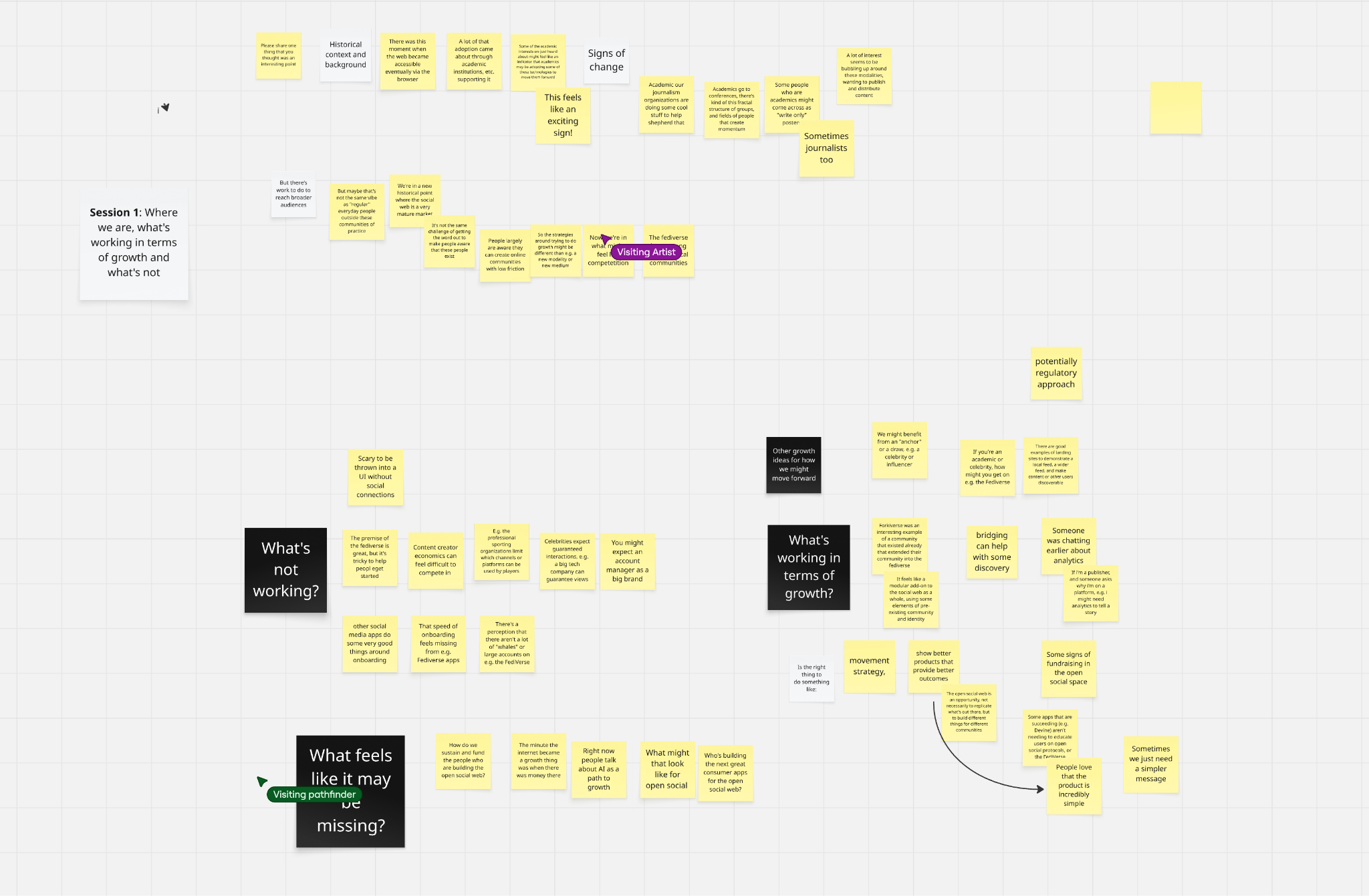
Session 1 notes: Where we are, what’s working in terms of growth and what’s not
-
Meta note: more stickies etc in “whiteboard” from the session
-
Protocols and building blocks allow for different communities to develop.
-
Universities have different requirements than community groups etc.
-
Opening the web came from Academia - but then it got commercialised
-
What growth strategies can we use? E.g. Discord and Reddit allow you to create a new community instantly - where’s the Fediverse equivalent?
- Ease of use and ease of movement essential
- Is Lemmy a model?
-
There’s more innovation that’s possible now
-
How do we attract big names to the Fediverse?
- Relationship managers for anchor personalities.
- Need to get high-profile names to feel safe
- That then attracts regular people
-
Businesses need analytics
- Give them tools to see why it is useful to be on the Fediverse
-
Instant gratification is missing
- Starter packs
- As easy as creating a new Group Chat on WhatsApp / Signal
-
Who is building “AirBnB” for the open social web
- That is, when can Fediverse be the substrate for something bigger?
Session 2 notes: Obstacles to further growth that we need to overcome
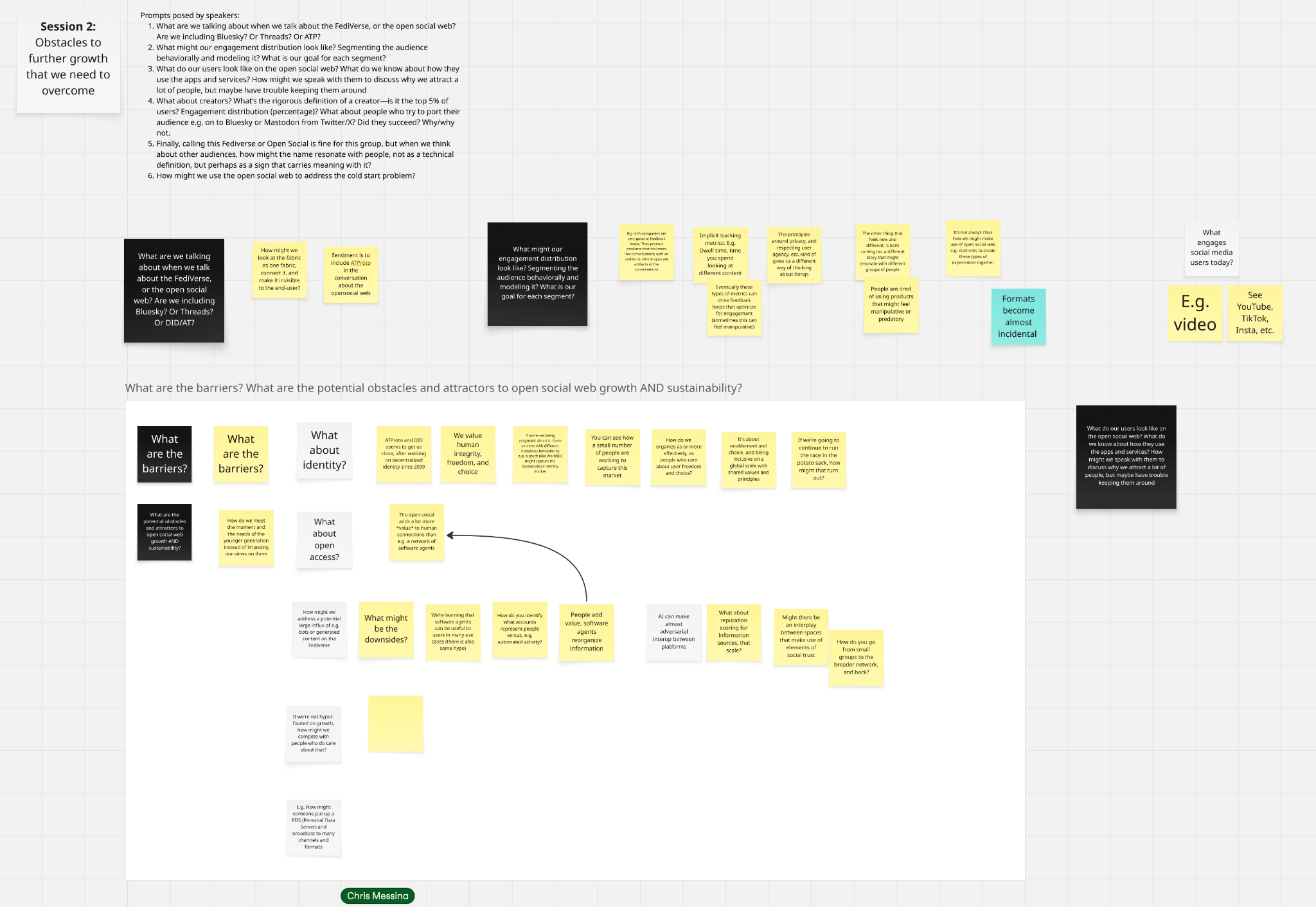
Prompts posed by speakers:
-
What are we talking about when we talk about the FediVerse, or the open social web? Are we including Bluesky? Or Threads? Or ATP?
-
What does our engagement distribution look like? Segmenting the audience behaviorally and modeling it? What is our goal for each segment?
-
What do our users look like on the open social web? What do we know about how they use the apps and services? How might we speak with them to discuss why we attract a lot of people, but maybe have trouble keeping them around
-
What about creators? What’s the rigorous definition of a creator—is it the top 5% of users? Engagement distribution (percentage)? What about people who try to port their audience e.g. on to Bluesky or Mastodon from Twitter/X? Did they succeed? Why/why not.
-
Finally, calling this Fediverse or Open Social is fine for this group, but when we think about other audiences, how might the name resonate with people, not as a technical definition, but perhaps as a sign that carries meaning with it?
-
How might we use the open social web to address the cold start problem?
Session 3 notes: After today, how will we move forward to grow?
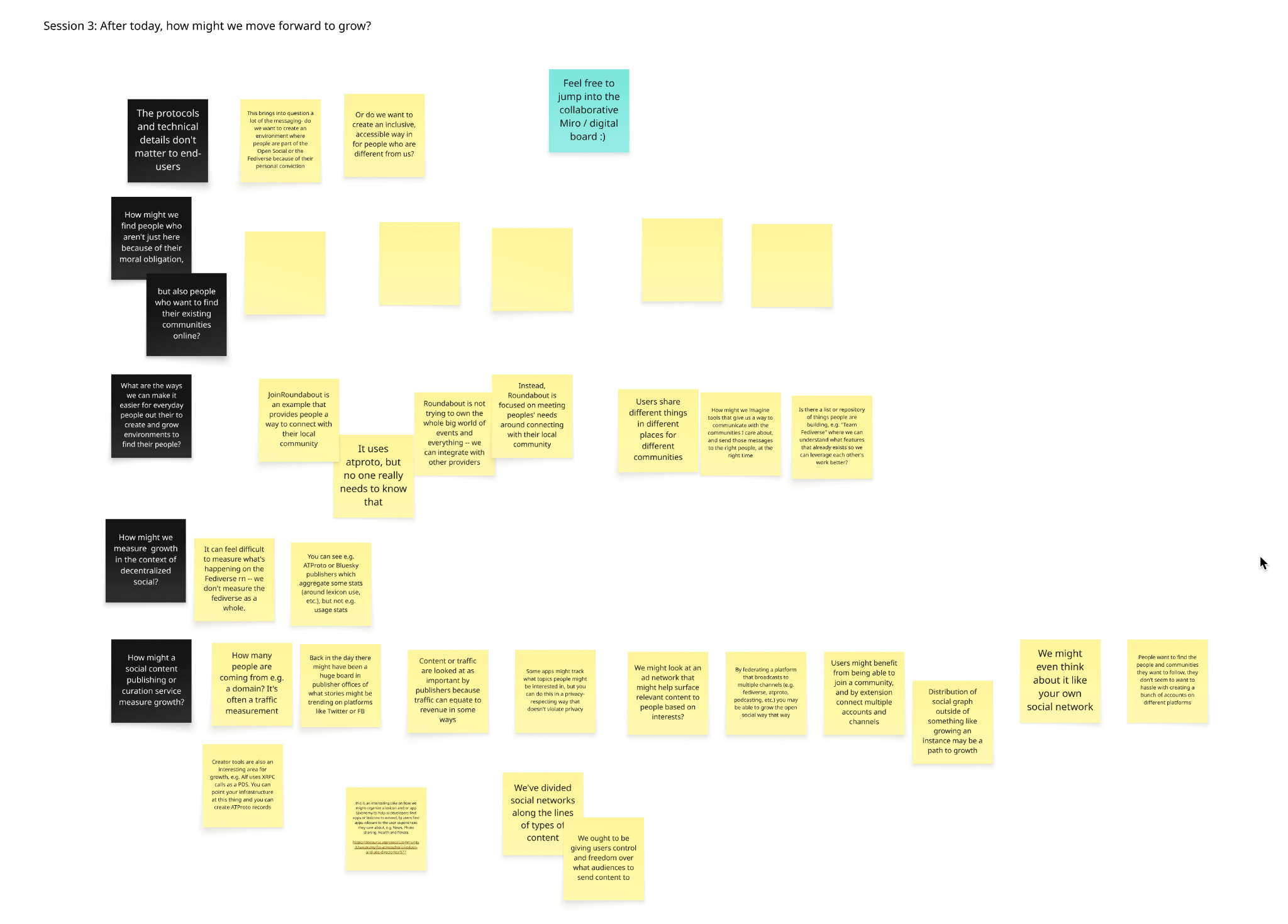
Table 6
Participants who wanted their participation recorded:
- Anthony Zone (@ozoned@btfree.social)
Table 7
Participants who wanted their participation recorded:
- Tara Raj (@enigmasnextdoor.bsky.social)
Table 8:
Participants who wanted their participation recorded:
- Jeremiah (@Jeremiah@alpaca.gold)
Session 1 notes: Where we are, what’s working in terms of growth and what not
-
Preaching about federation is not a selling point
-
“We don’t have ads, but we do have sex.”
-
You can do things that advertisers would never allow their ads to be beside.
-
Works as long as fediverse is community-led, but we may need to be open to business models and other financially sustainable revenue models at least for funding moderation
-
“If we don’t get 3.5B people off Facebook, society is doomed.”
-
Creator-selected advertisers (sponsors in their content) seems user-aligned an ok
-
Covering the costs by advertising: may not be viable, how does it not lead to enshittification?
-
Fediverse currently supported by Patreon, coops, hobbyists.
-
Earlier blogosphere was a healthier cultural ecosystem and had a variety of monetization models. Problem is that it didn’t grow beyond a certain group of people.
-
Ideal is individuals being able to choose a provider based on their values, whether free speech maximalist or moderated space or community-supported environment or subscription-supported or advertising-supported environment
-
“Not paying for it, you are the product” but we’ve seen community models where that isn’t true and we’ve seen you can still be the product sold even when you are paying for it
-
In a protocol world, we should see a bunch of experiments, but we haven’t seen that yet. We haven’t seen how the Web enabled a bunch of businesses sprout from its existence.
-
Probably is not a one true way. What can we do to enable more experimentation?
-
One ideal is that getting a social web account should be as easy as getting an email address. It proved a variety of service providers and business models were possible. People can set them up themselves or work or university or pay for SaaS or free/ad-supported service. ActivityPub basically works like email protocols, so why don’t email providers just also support ActivityPub? (Jeremiah agreed to be cited.)
-
Is the problem that we’re building protocols adjacent to the Web, but not based on the stuff that already exists on the Web? Why not use HTML, RSS, PUSH, etc instead of inventing new protocols?
-
https://docs.octothorp.es/ and https://octothorp.es/ < social / meta layer protocol for transforming HTML to other protocols with an inbuilt protocol for tags, links, and content sharing
-
Original Web value proposition of own your own stuff, create your own space, but we gave that up
-
Do we deny that we live in a post-capitalist extreme world or take that on directly?
-
Why is it not possible to do a decentralized Twitter?
-
Twitter never had mass appeal. Recreating it is not useful. Instagram, TikTok are fun.
-
Twitter and Bluesky were fun when they started, but now aren’t. Politics has taken over everything. Culture is leaving.
-
Bluesky wanted to make something easy to join, protocols to enable fun experimentation even if starting with a Twitter-like experience, but no longer the case for one person.
-
When something becomes popular, the culture changes
-
Someone tried to not bring their political baggage from Twitter to Bluesky, but politics is culture and what most people are talking about right now. Dynamic and entertaining for this person still.
-
The garden and stream talk referenced
- Maybe https://hapgood.us/2015/10/17/the-garden-and-the-stream-a-technopastoral/
- we need riparian zones along side the actual flowing water
-
Counter: Twitter is just a UX pattern that Bluesky, Threads, Mastodon also use.
-
we need new primitives in protocol level that are intentionally “garden”-like instead of “stream”-like.
Session 2 notes: Obstacles to further growth that we need to overcome
-
Something that stuck out: no aggregated metrics to look at limiting influence of the network
-
Media participation is a big thing. We need to get large organizations to participate. They care about metrics. They needs metrics to justify their effort.
- If a government is not convinced it can use your platform to get information out, they’re not going to use the platform. They’ll use whatever actually reaches people.
- Some orgs reporting getting more engagement from Bluesky now than Twitter due to Twitter’s link presentations changing.
- Value prop: own your own media identity in a more meaningful way.
- Value prop: own your data without threat of network operator shutting you down
-
What do they need?
- Tooling: either built themselves or providers they use. Need to add ActivityPub and ATProto support so they can see responses across all their social channels. Or guidance and approval up the chain to add the functionality.
- Perception: larger the ecosystems get, the more interest they have in participating.
- If you include Threads in ActivityPub ecosystem, then 98% of it is one player and media orgs don’t need to engage with the rest of the ecosystem. Similarly, AT Proto is just Bluesky today.
- Monetization methods needed in addition to metrics to help show the value of engagement. Not only fund the servers, but also the creators.
-
People advocating for protocols like RSS would have to convince users to also pick them up and many already use ActivityPub and AT Proto
- There were other IndieWeb protocols also created at the same time as ActivityPub that can be used, but they’re much less popular.
- Bridgy Fed has UX challenges. BlueSky does it well for finding a Mastodon user, but Mastodon user to Bluesky is still rough.
- RSS Parrot brings RSS to ActivityPub
-
How do people perceive fediverse and atmosphere differently?
- Robert’s position paper articulated this well (public, so attributing)
- General opposition to have one-vs-other or vibes-vs-vibes
- The bridges are needed
-
Orgs don’t have luxury of developers who can develop for both ActivityPub and AT Proto
-
ActivityPub is the only protocol demonstrating decentralization at scale from individual to hundreds of thousands of user instances.
- But Bluesky has an easier to recommend UX to someone who doesn’t care
-
What is the user-facing brand that’s not “the fediverse” to describe how things are compatible?
- Most people don’t care the protocol used
- Just call it Open Social again!
- Next Socials
- Public Spaces
-
“Matter compatible” and “Works with Hue” and “HomeKit compatible” are useful consumer labels. We need that for social too so people don’t have to care about the protocol differences.
- one of the platforms should try and claim Open Social and then if the two end up being compatible properly and seamlessly, then we can make them both OpenSocial compatible
-
What’s the product thing we say when we say “leave TikTok”?
-
Mastodon not being a good product hurts advocating for ActivityPub. People want to ActivityPub as an architecture and better future, but the UX of Bluesky today.
Session 3 notes: After today, how will we move forward to grow?
-
In EU, can argue that resilient infra is a compelling argument
- More public financing and procurement coming from EU now as a result of political instability
- One problem for the Commission is that many projects just aren’t mature enough to fund
-
What can FediForum do to build capacity to better meet EU granting needs? Can share news or convene discussions?
- Yes, discussion moved post-event
-
FediForum Connect new guide
- Reviews would be useful, powered by the fediverse
- Let me endorse it as a user
-
We need to match big platform capabilities
-
We know we can create niche communities: growing out of niches? Create networks of like minded people and institutions of all kinds.
-
Go public sector by public sector and get them adopting federated systems.
-
Maybe we don’t need to think about growth as needing private-sector-like growth, but focus on slow and steady.
- This is actually how most VC-funded SV actually grew and became dominant
-
We don’t care about the engine in our car, just getting from point a to point b
-
Purpose first - product built to suit. This is the whole problem with so-called AI wrecking the world right now. Everyone wants to make the latest, greatest hammer and sell it to everyone. But some of us want to decorate cakes.
Table 9:
Participants who wanted their participation recorded:
- Anthony Zone (@ozoned@btfree.social)
- Rory Mir (@falsemirror@masto.nyc)
- Babette Knauer (@babetteknauer@mastodon.social)
- Joan Pla (@joanpla@mastodon.social)
Notes:
Session 3 notes: After today, how will we move forward to grow?
-
How do we give communities the tools they need to join, share, and adapt?
-
here is the “Share to social” button? Make it as easy as Facebook was in the early days.
-
“Log in with” - again, easy on FB and Twitter, but not Fedit (See edent’s work on Auth0 + Masto)
Table 10:
Participants who wanted their participation recorded:
- Joe McLaughlin (@joemcl@mastodon.social)
- Anca Mosoiu (@anca@mastodon.xyz)
- Rory Mir (@falsemirror@masto.nyc)
Notes:
-
Question about Toot.wales app -
- The group loves that it’s a friendly app, you don’t have to be techy to use it.
- There is content available, you don’t have to struggle to find it.
-
Newsmast began by hand-curating some feeds, and are now working w/ some communities to build apps for each community that makes it easier for groups to onboarding
- Funded through grants, but later we’re going to charge a subscription fee that includes support, design, etc.
- In the community, a small percentage donate to keep things going - but we think this app will grow the community and therefore the donations.
-
“We can’t build community for the people - we’re not going to put out advertisements for example, but we can help with building the platform for the community”
-
We don’t use the word “Fediverse” when we talk to client, and very rarely “Open Social Web”. We talk about social media - things that they already know about.
-
Building community isn’t just “Leave X” and come over here. It’s “start building, and bring your most important followers here” and keep going…
Table 11:
Participants who wanted their participation recorded:
- William Maggos (@wjmaggos@liberal.city)
Notes:
- Trying to come up with positive reasons to join fedi, maybe the forkiverse is the best example. When people show up, they need friends or they leave. They need more guidance. Also need ways to manage any push back on how they are doing things wrong.
Table 12:
Notes:
-
Which are we optimizing for: virality or community?
- Social media vs. social marketing
-
Should growth be wide or deep?
- Wide: Public, virality, OG Twitter, town square
- Deep: Tight-knit communities, personal relationships, classic Facebook
-
Incentives for enticing creators
- Reach
- Micropayments
- Data sovereignty
Table 13:
Participants who wanted their participation recorded:
- Ezra Boeth (@ezraboeth.com)
- Mark Corbett Wilson (@mcorbettwilson@mastodon.social)
- Ním Daghlian (@octothorpes@hachyderm.io)
- Anca Mosoiu (@anca@mastodon.xyz)
Notes:
-
Mike Caulfield’s Garden and Stream -
- Consider two experiences: Garden, where you browse and look based on your interest, and stream, where things come by
-
A question that one of our participants get asked: Artists who use instagram to market themselves: Is Pixelfed the right place to go and do this next?
- They want to leave Instagram so their content won’t be used for training data
- There’s an instance on pixelfed for the artists. The problem is that pixelfed is done
by one guy, and he’s not open to suggestions.
- We want to use anti-AI image tools
- We want to take our POC to other cultural institutions
-
How to untangle the connection between the technology and the community - having the technology does not guarantee the community will be there
-
Ruben R. Puentedura’s SAMR Model: Substitution, Augmentation, Modification, Redefinition
-
Find the communities that need the technology we have
-
Discussion about centralized identify
-
Clarify that there is some confusion about the functions of the protocols, and what they can support in terms of social interaction. Would be helpful to clarify
-
ATProto is completely open, and that changes how people interact with apps built upon it
- Though many apps have private data off-protocol
- And private data is coming to ATProto in the future
-
PLC (identity layer for ATProto) is centralized, which has both benefits and risks.
Table 15:
Participants who wanted their participation recorded:
- Chris Messina (@chrismessina.me)
Notes:
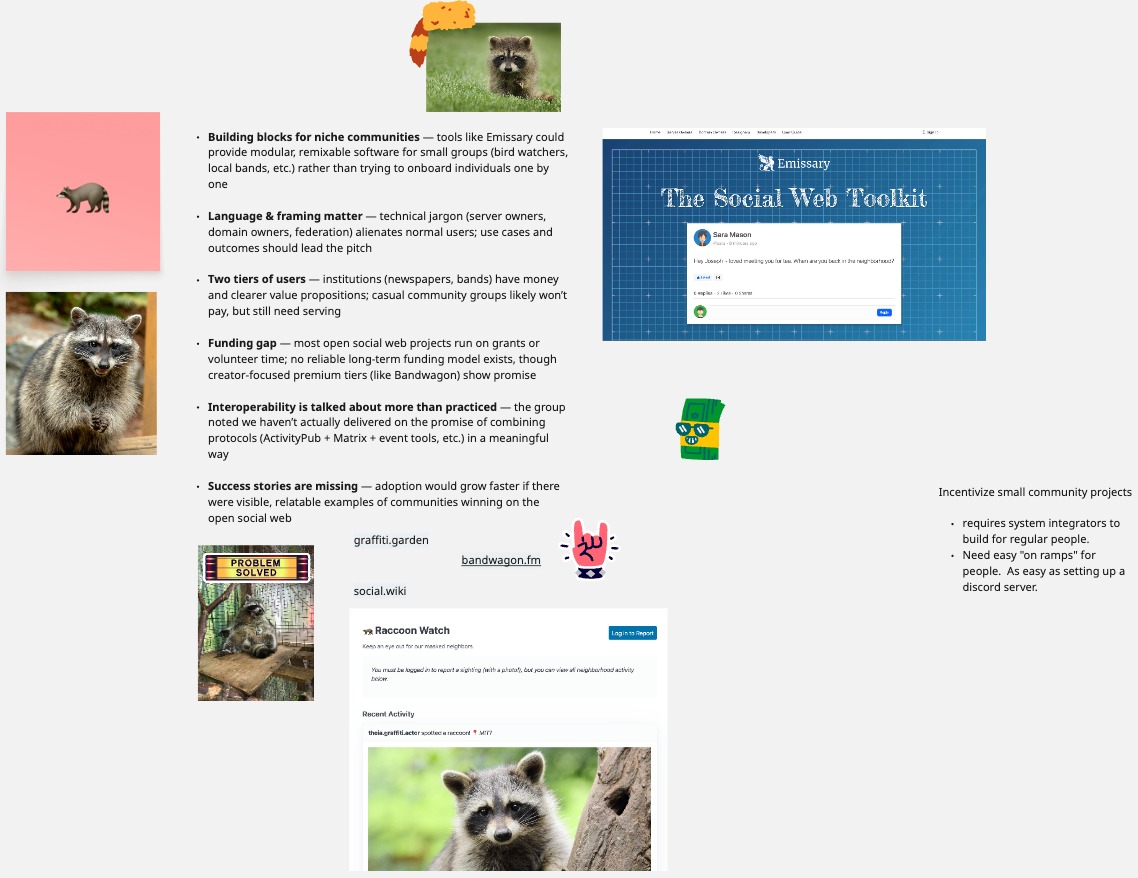
Related whiteboard:
-
Emissary Platform (Ben’s project)
- Core platform with replaceable skins for specific communities
- Similar approach to Bonfire - small niche applications
- Current example: Bandwagon (Bandcamp alternative for musicians)
- Challenge: Activity Pub difficult to build on, needs more accessible tooling
-
Funding and Accessibility Barriers
- Average users can’t host servers - need intermediary solutions
- System integrators could serve specific communities (raccoon watchers, bird watching groups)
- Lack of marketing budgets for decentralized projects limits awareness
- Need “Wix for open social web” - drag-and-drop building blocks
-
Growth Strategy Insights
- Focus on institutional users with money vs social community groups
- Success stories and viral examples missing from current messaging
- Need remixable apps with ChatGPT/Claude integration for instant deployment
- Technical barriers surmountable if real value demonstrated
-
Alternative Approaches
- Social Wiki project on Graffiti protocol
- editable social apps
- Plus-one policy for public institutions (support at least one interoperable protocol)
- Different tiers: institutional paying users vs free community groups
- Social Wiki project on Graffiti protocol
Table 18:
Notes:
-
Framing of “Growing the Open Social Web”
- Spotlights openness … fedi also includes a critique of openness, tension field
- Erases differences. “Free fediverse” is different from “corporate fediverse” is different from Bluesky is different from Blacksky
-
Plurality. Connected Places, plural
-
Is growth a goal? Want to get people off corporate social networks
-
There are three parts going on at the same time:
- Shrink the user base of the Big tech platforms
- Grow specific digital places (whether that’s Blacksky, hachyderm.io, etc)
- Grow the usage of open-protocol-based infrastructure (which allows doing stuff like Tangled)
-
We’re talking about many things, we can say we’re servers, we can say we connect services, but what do we mean? Benefits of having a non-branded digital life vs. the focus on a platform brand – the name derives from the company. Referring it to the company makes it easy to understand, but the thing behind it is more difficult to describe. What’s the equivalent of “the Tumblr vibe”?
-
Can use my handle to federate to whatever I want, instead of registering again with everything – super-powerful, also a bit daunting.
-
Toot.wales is a great example. Long-lasting fedi instances tend to have a center: geographical, community of practice like infosec, existing community like chaos.social. Blacksky and Northsky are heading that way as well.
-
Stuff like that is the best way where open social web can grow. TikTok, Insta are windows to the entire web, shouldn’t be trying to recreate that – maybe facets. If the context-specific value of different instances/servers is communicated better, people would better understand – different, more tapped in to those around me and I care about. The reason people used social media initially was to be connected to friends and family; now it’s connected to the world at large (and for advertisers to sell things to you)
-
Can grow without evangelizing people to leave the old social networks – I’m still on Insta. I think it’s like a lifeboat, not a transfer.
-
People are multi-faceted, the belong to multiple communities at once. People who found their identities in AOL chatrooms, multiple reasons people are online, narrowing the scope doesn’t help. View it more as the web itself. The person is central, they’re in all these different communities, it’s the human web that we need to be solving for. Not just social networking or social media, it’s both. They want to connect with people, and also connect and consume content. Keep an open mind, a very broad approach, will help us get there. Fedi often views it from a narrow and conservative lens, it does nobody any good. That’s how we ultimately win and grow in the long run, not trying to narrow and fit everything into an instance. Need to challenge fedi’s mental model of what growth is – not just the VC focus, growth can mean many things.
-
Relates to the eternal discussion of onboarding. What are people joining? With toot.wales it’s clear what they’re joining and why. For some people multiple handles works, others want a single identity to use. One of the issues to solve is making the first choice – what is your identity, where are you. Or start from mastodon.social and there you are.
-
Events – in-person, even online – key part of community. Commercial social networks aren’t good at community, FB groups aren’t what they were
-
What was Mastodon like in 2017, were these tensions already there?
-
From 2017: https://privacy.thenexus.today/lessons-so-far-from-mastodon-for-independent-social-networks/
-
History: https://privacy.thenexus.today/mastodon-a-partial-history/
-
Community aspects vs Twitter alternative: https://privacy.thenexus.today/a-tale-of-two-prototypes-2/
-
Digging in more to why people consider coming and leave, interesting? Yes! Suggestion of using pol.is
-
Here’s Erin’s informal work, very relevant - https://erinkissane.com/mastodon-is-easy-and-fun-except-when-it-isnt